Understanding Durability: Water Resistance, Abrasion Testing and BS 5609 Certification
What Makes a Printed Label Durable?
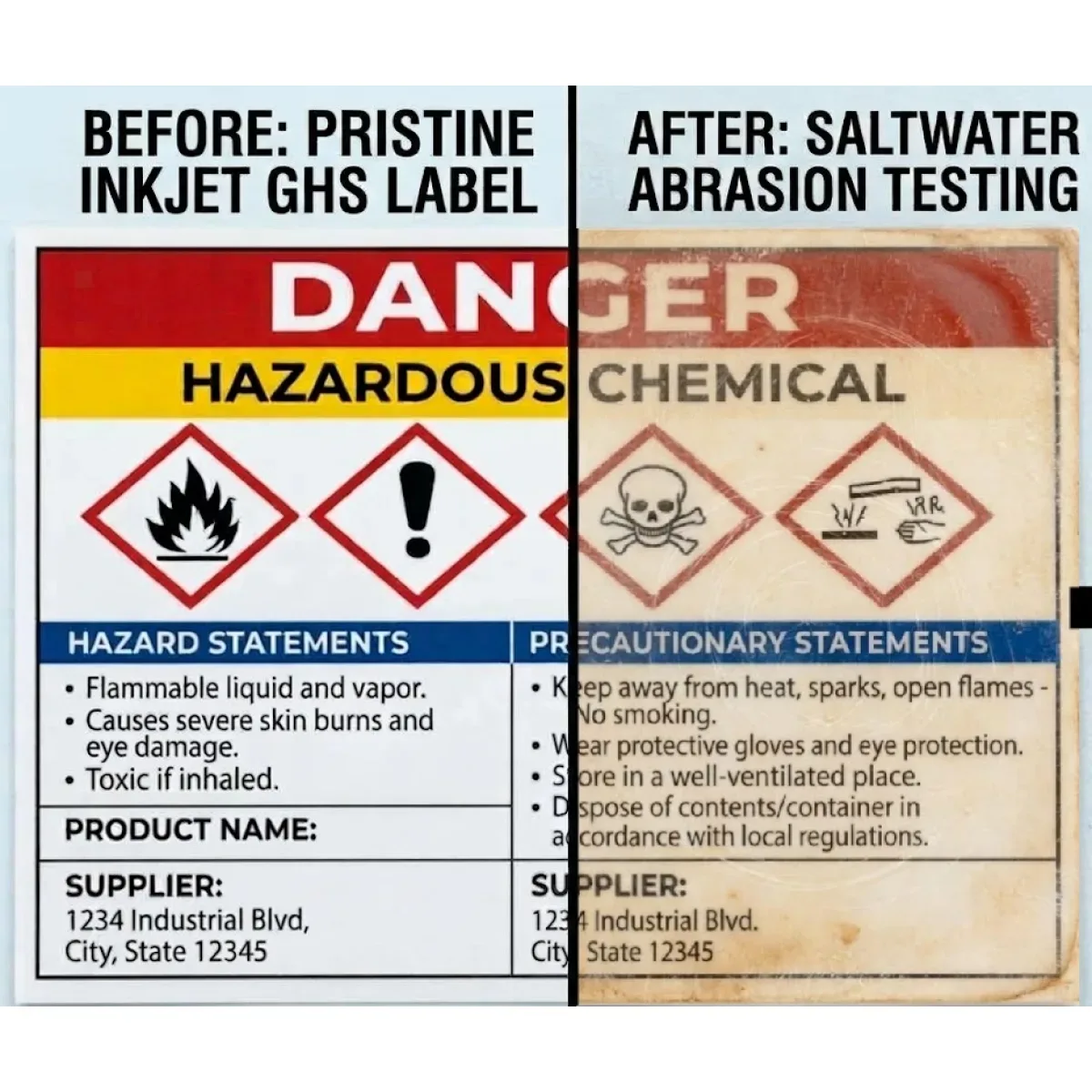
When selecting a colour label printer, one of the most important considerations is how well the finished label will withstand the environment in which it will be used. Request a Sample today to test.
A label may look excellent immediately after printing, but its long-term durability depends on much more than print quality.
Water, moisture, sunlight, chemicals, temperature, friction and everyday handling can all affect the printed image, label surface and adhesive.
Manufacturers frequently describe their printing technologies as water-resistant, abrasion-resistant, chemical-resistant or BS 5609 compliant. These claims provide useful information, but they do not mean that every label produced by the printer will withstand every environment.
For example, a label may resist occasional rain or splashing but gradually deteriorate when repeatedly rubbed with wet fingers. Similarly, a printed label may pass an internationally recognised marine durability test while still showing visible surface wear.
The Epson ColorWorks CW-C6510A Matte and OKI Pro1050 are two examples of colour label printers capable of producing BS 5609-compliant labels when used with approved materials.
Although both technologies can produce durable labels, they use fundamentally different printing processes.
Understanding these differences, the purpose of durability testing and the benefits of additional protective coatings or laminates can help businesses choose the most appropriate solution.
Understanding the Different Types of Label Resistance
Label durability is not a single characteristic. Different environments place different demands on the printed image, its surface coating, the label substrate and the adhesive. This is why testing within your own environment to meet your requirements is required.
Water and Splash Resistance
Water resistance describes a printed label’s ability to withstand exposure to water without unacceptable deterioration.
A water-resistant label may tolerate occasional splashes, condensation, humidity or rain without the printed image immediately running or bleeding.
Both pigment inkjet and dry toner printing can produce water-resistant labels when combined with suitable synthetic materials.
However, splash resistance does not automatically mean the label will withstand prolonged immersion, pressure washing or repeated rubbing while wet.
Abrasion and Rub Resistance
Abrasion resistance measures how well a printed surface withstands mechanical contact.
This may involve friction against packaging, contact with abrasive particles or rubbing against another surface.
Different testing methods use different materials, mechanical loads, speeds and numbers of cycles.
Consequently, passing one abrasion test does not guarantee resistance to every type of rubbing.
A label that withstands a defined marine abrasion test may still experience damage when repeatedly rubbed with fingers, cleaning cloths or other packaging materials.
Chemical Resistance
Chemical resistance describes how well the label withstands exposure to specific substances, including oils, alcohol, detergents, solvents and cleaning chemicals.
Resistance is highly dependent on the particular chemical, its concentration, exposure time and whether the printed surface is rubbed during contact.
A label that withstands water may not tolerate alcohol or a concentrated cleaning agent.
UV and Environmental Resistance
Labels exposed to sunlight, heat, refrigeration, humidity or outdoor weathering may experience fading, discolouration, adhesive failure or material deterioration.
The appropriate testing depends on the intended environment and required service life.
A warehouse identification label and an outdoor chemical drum label may require very different levels of durability.
Epson ColorWorks CW-C6510A Matte: Pigment Inkjet Printing
The Epson ColorWorks CW-C6510A is an industrial colour inkjet label printer designed for on-demand production of product, chemical, warehouse and identification labels.
The Matte configuration uses Epson UltraChrome DL pigment-based inks, consisting of Cyan, Magenta, Yellow and Matte Black.
Pigment inks use colour particles rather than dissolved dyes. When deposited onto a compatible inkjet-receptive label material, they can provide good resistance to water and environmental exposure.
The printer uses Epson PrecisionCore inkjet technology, producing detailed colour graphics, text and barcodes at resolutions up to 1200 × 1200 dpi.
Why the Label Material Matters
A pigment inkjet label is not simply ink printed onto plastic.
Many synthetic inkjet materials incorporate a specially formulated surface coating that accepts and retains the pigment ink.
This coating contributes significantly to the printed label’s appearance and durability.
Even when the pigment ink itself has good water resistance, the ink-receptive coating may be affected by friction, incompatible chemicals or repeated wet handling.
The printed surface can therefore deteriorate without the underlying synthetic material being destroyed.
Epson BS 5609-Certified Media
Epson has documented BS 5609-compliant configurations using UltraChrome DL pigment inks and approved synthetic label materials.
These include specific PE Matte synthetic label products and other approved constructions.
Epson PE Matte media is designed for demanding identification applications, including chemical and laboratory labelling.
However, certification applies to the tested combination of printer, ink and label material.
Using a BS 5609-capable printer with an arbitrary paper or synthetic label does not automatically produce a certified label.
Where Epson Pigment Inkjet Labels Are Suitable
With appropriate media selection, Epson ColorWorks pigment inkjet printing is well suited to applications such as:
- Chemical and GHS identification labels.
- Industrial product identification.
- Warehouse and logistics labels.
- Pharmaceutical and laboratory identification.
- Short-run colour product labels.
- Applications involving occasional moisture, splashing or rain.
For applications involving continuous friction, repeated wet handling or aggressive chemicals, additional testing and potentially protective finishing are recommended.
OKI Pro1050: Digital LED Dry Toner Printing
The OKI Pro1050 uses a different approach to colour label production.
Instead of liquid pigment ink, it uses digital LED electrophotographic printing with dry micro-crushed toner.
The Pro1050 features five-colour printing: Cyan, Magenta, Yellow, Black and White.
The additional white toner allows printing onto transparent, coloured, dark and compatible metallic label materials.
This makes the OKI Pro1050 particularly useful for decorative product packaging, premium labels and applications where opaque white printing is required.
How Dry Toner Printing Works
In dry toner printing, electrically charged toner particles are transferred to the label material and fused to the surface using heat and pressure.
Unlike pigment inkjet printing, the process does not rely on a conventional aqueous ink-receptive coating to absorb liquid ink.
The resulting printed surface can provide useful resistance to moisture and handling when produced on compatible media.
However, toner is not indestructible.
Depending on the material and operating conditions, repeated abrasion, flexing, chemicals or mechanical contact can still damage or remove the printed toner.
Is the OKI Pro1050 BS 5609 Certified?
Yes. The OKI Pro1050 has independently documented BS 5609 Section 3 certification.
Smithers Pira tested the OKI Pro1040 and Pro1050 using CMYK micro-crushed toner on Matte White PE synthetic label material.
The certificate, dated 19 September 2017, confirms that the printed label construction passed the relevant BS 5609:1986 Section 3 tests.
These included:
- Print key effectiveness.
- Abrasion resistance.
- Permanence of print.
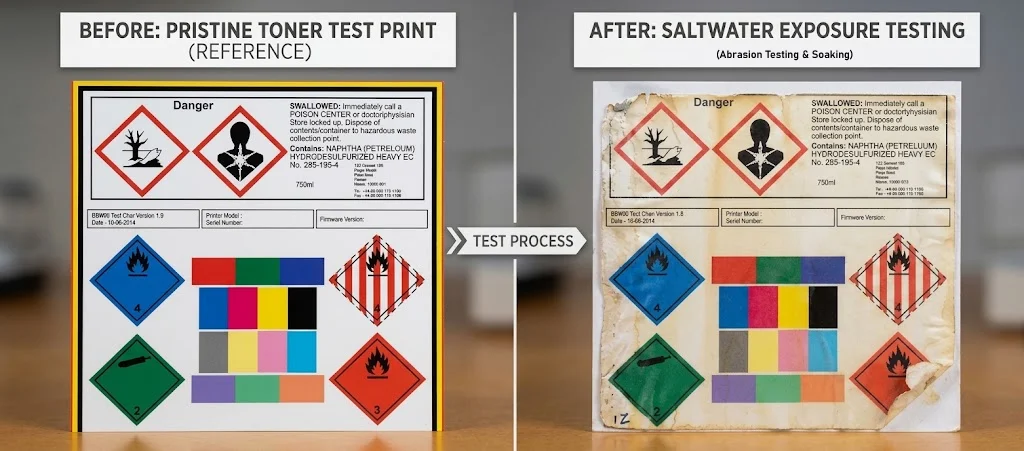
PPG also identifies a specific TESLIN label construction printed using the OKI Pro1050 as having achieved BS 5609 Section 3 certification.
These approvals apply to the specified materials and printing configurations, not every material compatible with the printer.
Where OKI Dry Toner Labels Are Suitable
When used with appropriate media, the OKI Pro1050 is suitable for evaluating applications including:
- Industrial and chemical identification.
- Product packaging and branding.
- Transparent and coloured labels requiring white printing.
- Household and personal care products.
- Outdoor and moisture-exposed identification.
- Short-run labels requiring variable information.
OKI also promotes compatible label constructions for resistance to water, oils, chemicals and environmental exposure.
As with any printing technology, these properties depend on the selected material and the actual conditions of use.
Comparing Epson Pigment Inkjet and OKI Dry Toner
Both printing technologies offer advantages, but their different processes can influence how the finished label responds to environmental conditions.
| Characteristic | Epson CW-C6510A Matte | OKI Pro1050 |
|---|---|---|
| Printing technology | PrecisionCore pigment inkjet | Digital LED electrophotographic |
| Colour system | CMYK | CMYK + White |
| Ink or toner | UltraChrome DL pigment ink | Micro-crushed dry toner |
| Printing process | Liquid pigment ink deposited onto compatible media | Dry toner transferred and heat-fused |
| Typical label materials | Compatible coated paper and synthetic inkjet media | Compatible paper, synthetic and specialty toner media |
| BS 5609 Section 3 | Yes, with approved media | Yes, with approved media |
| Splash resistance | Available with suitable synthetic media | Available with suitable synthetic media |
| Abrasion resistance | Depends on ink and media combination | Depends on toner and media combination |
| Repeated wet rubbing | Requires application testing | Requires application testing |
| Clear and coloured media | Depends on suitable material and artwork | White toner provides additional design flexibility |
| Protective lamination | Can improve durability | Can improve durability |
Neither printing technology should automatically be considered superior in every durability application.
A particular toner label may outperform a particular pigment inkjet label under one condition, while the opposite may occur under another.
The finished label construction and actual operating environment determine suitability.
What Is BS 5609?
BS 5609 is a British Standard covering printed pressure-sensitive adhesive labels intended for marine use.
It is widely recognised in industrial and chemical labelling, particularly for containers that may encounter demanding shipping and environmental conditions.
Although widely recognised internationally, BS 5609 is a British Standard rather than an ISO standard.
The standard evaluates specific aspects of label material and printed image durability.
Section 2: Label Material Performance
Section 2 addresses the performance of the adhesive label stock.
This includes properties relevant to adhesion and environmental durability.
The material must remain suitable for its intended purpose, independently of whether the printed information remains readable.
Section 3: Printed Label Performance
Section 3 evaluates the durability of the printed image.
Under the established testing framework, this includes:
- Print key effectiveness.
- Abrasion resistance.
- Permanence of the printed image.
This section is particularly relevant when manufacturers describe their printing systems as BS 5609 compliant.
How Is BS 5609 Abrasion Testing Performed?
One of the most misunderstood aspects of BS 5609 is how abrasion resistance is tested.
The established BS 5609:1986 Appendix J method uses a rotating apparatus containing metal rods, sand and saline solution.
It is considerably different from rubbing a label with a finger or applying a weighted cloth directly onto the printed surface.
Preparing the Printed Label
The printed label is applied to a cylindrical metal rod.
The sample is conditioned for approximately 24 hours at 23°C and 50% relative humidity, within specified tolerances.
It is then immersed in saline solution for a further 24 hours at approximately 23°C.
This exposes the printed label to saltwater before abrasion testing begins.
Performing the Abrasion Test
The labelled rod and another metal rod are placed inside a rotating container.
A mixture of washed sand and saline solution is added.
The established method uses the following conditions:
| Parameter | BS 5609:1986 method |
|---|---|
| Abrasive material | Washed sand |
| Liquid | Saline solution |
| Sand proportion | 20% by volume |
| Saline proportion | 80% by volume |
| Rotation speed | 20–25 RPM |
| Number of revolutions | 500 |
| Approximate duration | 20–25 minutes |
| Separately calibrated downward rubbing force | 0 |
| Previous saltwater immersion | 24 hours |
The salt dissolves in the water, while the fine sand remains as solid abrasive particles floating in the solution.
As the container rotates, the metal rods move and make contact while exposed to the abrasive mixture.
There is no separately specified downward rubbing force comparable to a person pressing a finger against the label.
This is a defined wet abrasion test rather than a simulation of every type of handling or rubbing.
What Does Passing the Abrasion Test Actually Mean?
A BS 5609 abrasion test does not require the printed label to remain completely undamaged.
The test evaluates whether the printed image meets specified acceptance criteria after abrasion.
These include whether colours remain recognisable, whether colour changes remain within the permitted limits and whether printed text and symbols remain identifiable.
A label may show visible surface wear or some print removal while still passing.
This is an important distinction between functional durability and cosmetic appearance.
A chemical warning label may remain suitable because the printed safety information is still readable.
However, a premium cosmetic label with the same visible damage may no longer meet the brand owner’s appearance requirements.
Actual OKI Pro1050 Abrasion Test Results
The independent Smithers Pira report for the OKI Pro1040 and Pro1050 provides an excellent example.
During the abrasion testing, the laboratory recorded slight or very slight print removal across the evaluated colours.
Despite this visible damage, the printed labels passed.
The report recorded the following abrasion results:
| Printed colour | Grey scale rating | Laboratory observation | Result |
|---|---|---|---|
| Black | 4 | Slight print removal | Pass |
| Red | 4 | Slight print removal | Pass |
| Green | 4.5 | Very slight print removal | Pass |
| Dark Blue | 4.5 | Very slight print removal | Pass |
| Blue | 4.5 | Very slight print removal | Pass |
| Magenta | 4 | Slight print removal | Pass |
| Yellow | 4.5 | Very slight print removal | Pass |
The report also recorded some print fading during the separate permanence testing, while confirming that the printed labels passed the relevant requirements.
This demonstrates that BS 5609 certification does not necessarily mean zero abrasion damage or zero colour change.
The requirement is to meet the specified performance criteria.
These results relate to the tested OKI CMYK configuration and should not be interpreted as separate certification of white toner on every material.
Why a BS 5609-Certified Label May Still Rub Off
Consider a shampoo bottle printed using either the Epson CW-C6510A Matte or OKI Pro1050.
The printed label may withstand occasional water splashes without the image immediately bleeding or deteriorating.
However, normal use introduces several additional stresses.
The customer may repeatedly squeeze the bottle, rub the label with wet fingers, handle it with shampoo on their hands or leave it in a humid bathroom.
Shampoo and detergents contain surfactants that can influence how moisture interacts with the printed surface.
Repeated rubbing can gradually damage ink, toner, coatings or the underlying material.
Squeezing the bottle can also flex the label, potentially stressing the printed surface and adhesive.
These conditions are different from the BS 5609 marine abrasion test.
Therefore, a label can pass BS 5609 while still being unsuitable for a particular shampoo, cosmetic or household product.
This does not necessarily indicate defective printing equipment or materials.
It may simply mean that the selected label construction is not appropriate for the application.
Splash and Rain Resistance Versus Repeated Wet Rubbing
For many industrial applications, occasional water exposure is the primary concern.
Examples include warehouse products exposed to condensation, outdoor containers caught in rain and industrial equipment subject to occasional splashes.
Appropriately selected Epson pigment inkjet or OKI dry toner labels can provide useful resistance to these conditions.
However, three situations should be considered separately.
Occasional splashing: Water contacts the printed surface briefly before draining or drying.
Prolonged exposure: The label remains wet or immersed for an extended period.
Repeated wet rubbing: The label is mechanically rubbed while exposed to water, detergent or another liquid.
Each condition can produce a different result.
A label that survives the first two may still be damaged by the third.
Water resistance and repeated wet-rub resistance are not interchangeable.
Protecting Printed Labels with Lamination and Clear Over-Patches
For applications requiring greater protection against rubbing, handling and environmental exposure, an additional protective layer can make a substantial difference.
Two common options are clear overlamination and clear protective over-patches.
Clear Overlamination
Overlamination involves applying a transparent protective film over the printed label.
Depending on the equipment and production process, this may be applied across the printed roll or as part of a separate finishing operation.
Common options include clear polypropylene and polyester films, with different thicknesses, adhesives and finishes.
A suitable laminate provides a physical barrier between the printed image and the environment.
This can substantially improve resistance to surface scratching, rubbing and everyday handling.
It may also improve protection against moisture, oils and certain chemicals, depending on the laminate construction.
For example, a shampoo bottle label that experiences surface wear during repeated handling may perform considerably better with a suitable protective laminate.
However, lamination does not automatically make the label resistant to every chemical or suitable for every flexible container.
The laminate must also withstand the intended handling, bending, temperature and exposure conditions.
Clear Protective Over-Patches
An alternative is to apply a transparent self-adhesive protective patch over an existing printed label.
These are sometimes called clear over-patches, protective overlays or clear overlabels.
They are particularly useful when only a small printed area requires additional protection.
Examples include:
- Equipment identification and serial number labels.
- Barcodes and QR codes exposed to repeated scanning and handling.
- Industrial warning labels.
- Labels on frequently handled containers.
- Printed identification labels that may be cleaned or wiped regularly.
A clear over-patch provides a replaceable or additional physical barrier over the printed image.
This can be a practical solution when full-roll lamination equipment is not available.
Choosing the Correct Protective Film
Not all transparent films provide the same protection.
A protective film should be selected according to the intended environment, including:
- Resistance to abrasion and scratching.
- Compatibility with water, oils and chemicals.
- UV resistance where outdoor exposure is expected.
- Flexibility for curved or squeezable containers.
- Adhesive compatibility with the underlying label.
- Optical clarity and barcode readability.
A protective film that works well on a rigid metal container may not be suitable for a flexible shampoo bottle.
Likewise, a film designed primarily for appearance may offer less chemical resistance than a specialist industrial protective overlay.
Does Lamination Make a Label BS 5609 Certified?
Adding lamination can improve the durability of a printed label, but it does not automatically establish or extend BS 5609 certification.
If formal certification is required, the relevant printed label construction, including any protective film where applicable, must be covered by appropriate testing and documentation.
A laminate should therefore be viewed as an additional protection option rather than a substitute for certification.
Other Label Durability Testing Methods
BS 5609 is only one method of evaluating label performance.
Depending on the application, other tests may be more appropriate.
Controlled Rub Testing
Laboratory equipment can repeatedly rub a printed surface using defined contact materials, mechanical loads and cycle counts.
Testing may be performed dry or wet.
This can provide useful information for labels exposed to frequent handling or cleaning.
Chemical Exposure Testing
Printed labels can be exposed to specific chemicals for defined periods and then evaluated for print removal, colour changes, surface deterioration or adhesive failure.
Where practical, testing should use the actual chemicals and concentrations expected during normal use.
Weathering and UV Testing
Accelerated environmental testing can help evaluate colour stability, material degradation and adhesive performance under sunlight, humidity and temperature exposure.
Adhesion and Flexibility Testing
Labels applied to curved, flexible or squeezable containers may require additional testing to determine whether they remain attached and whether the printed surface tolerates repeated deformation.
These tests can be especially important for cosmetics, household products and flexible packaging.
Why Customers Must Test Labels Under Their Actual Conditions
Manufacturer specifications and certification results provide valuable guidance when selecting printing equipment and label materials.
However, no single certification can reproduce every environment in which a label may be used.
Before committing to a printing solution, customers should evaluate printed samples using their actual product, container and operating conditions.
For example, a shampoo bottle label should be applied to the intended bottle and tested through repeated wet handling, squeezing and exposure to the shampoo itself.
A chemical label should be tested against the substances and cleaning processes relevant to its application.
A refrigerated food label may require testing for condensation, temperature changes and adhesion to cold packaging.
An outdoor equipment label may require testing for sunlight, rain and long-term weather exposure.
A Practical Label Evaluation Process
- Identify the environment. Determine whether the label will encounter moisture, chemicals, abrasion, sunlight, temperature changes or repeated handling.
- Select suitable materials. Choose compatible label stock and adhesive properties for the intended surface.
- Print representative samples. Use the actual printer, ink or toner, print settings and artwork.
- Apply the labels to the finished product. Test on the real container or surface.
- Reproduce normal handling. Include rubbing, squeezing, cleaning, storage and chemical exposure where relevant.
- Evaluate protective finishing. Compare unprotected labels with suitable laminated or over-patched versions if additional protection may be required.
- Inspect the results. Check print legibility, appearance, barcode readability, coating condition and adhesive performance.
- Confirm suitability before production. Establish whether the finished label meets the application’s functional, appearance and service-life requirements.
For demanding applications, customers should establish their own acceptable performance criteria before testing.
A label that remains readable but shows visible wear may be acceptable for industrial identification, while the same result may be unacceptable for premium retail packaging.
Conclusion: Certification Is a Starting Point, Not a Guarantee
The Epson ColorWorks CW-C6510A Matte and OKI Pro1050 demonstrate how different printing technologies can produce durable colour labels suitable for a wide range of industrial and commercial applications.
The Epson uses UltraChrome DL pigment-based inkjet printing, while the OKI uses digital LED dry toner printing.
Both have documented BS 5609-compliant configurations when used with approved synthetic label materials.
These certifications provide meaningful evidence of durability under defined test conditions, including wet abrasion.
However, the actual OKI laboratory results demonstrate an important limitation: a printed label can experience visible toner removal and still pass BS 5609 abrasion testing.
The standard does not require the printed image to remain completely undamaged. It requires the printed information to meet specified acceptance criteria, including remaining recognisable and identifiable.
A label that withstands occasional splashing, rain or marine abrasion testing may still experience surface damage when repeatedly rubbed, squeezed or exposed to detergents.
For applications requiring greater protection, clear lamination films and self-adhesive protective over-patches can be purchased and applied over the printed label.
These additional protective layers can substantially improve resistance to everyday rubbing, scratching and handling by providing a physical barrier over the printed image.
They can be particularly beneficial for frequently handled products, equipment labels, cosmetics and containers exposed to moisture.
However, protective films must also be selected and tested for the intended environment.
At Printer Power, we recommend evaluating the complete combination of printer, ink or toner, label material, adhesive and any protective laminate before committing to production.
We can assist with material selection and printed samples for evaluation.
Because every application has different requirements, the end user is responsible for testing and confirming that the finished labels are suitable for their intended use.
Whether using Epson pigment inkjet, OKI dry toner or another printing technology, the most important measure of durability is not simply whether the label has passed a recognised test.
It is whether the finished label, with or without additional protective lamination, performs satisfactorily throughout the actual life of the product.