View Resin Thermal Transfer Ribbons Ink Out
Australia’s hazardous-chemical labelling workflow is entering an important review period. Safe Work Australia’s current guidance notes updates to the Hazardous Chemical Information System (HCIS) for workplace exposure limits commencing on 1 December 2026. This is a practical readiness milestone for organisations that manufacture, import, repackage, supply or use hazardous chemicals: review the classification and safety information that feeds labels, then ensure the physical label remains readable in its working environment.
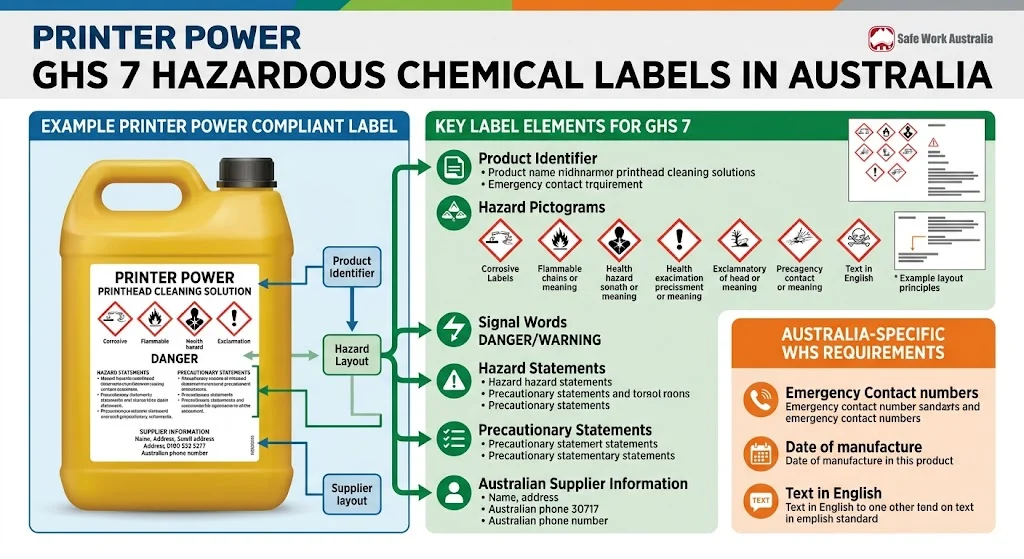
Why chemical label reviews need a production workflow
Hazardous-chemical labels are not a one-time artwork exercise. Manufacturers and importers, including businesses that repackage or relabel chemicals under their own name, must label hazardous chemicals correctly. Suppliers must not provide chemicals they know, or ought to know, are incorrectly labelled. Workplace users also need to manage labels on decanted containers.
A label review should therefore connect the current classification and safety data to the labels used on original containers and smaller transferred containers. The process needs to account for the label’s available space, required information, intended container surface and the conditions that may affect legibility after application. A label that begins clearly but becomes smeared, scratched or detached can weaken the usefulness of hazard and handling information in day-to-day work.
Operational requirements for durable hazardous-chemical labels
A practical workflow begins by identifying the container, the information to be printed and the exposure profile. Chemical drums, bottles and decanted containers can face frequent handling, moisture, abrasion, temperature exposure and contact with chemicals. The label material, adhesive and printed image should be selected as a system for that specific environment.
Thermal-transfer printing uses a heated printhead to transfer a ribbon coating to the label surface. It is commonly used where printed information needs greater long-term robustness than direct thermal printing. However, ribbon choice should not begin with selecting the most durable formulation by default. The required outcome depends on the service conditions, label facestock and the production pace needed by the operation.
- Information control: Review label data when classifications or SDS-linked information change, including the HCIS updates associated with workplace exposure limits commencing on 1 December 2026.
- Container workflow: Account for original containers, repackaged products and decanted containers that require identification in the workplace.
- Substrate selection: Match the label construction to the container surface and expected exposure, rather than treating the face material as a passive carrier.
- Print readability: Consider barcode, text and graphic clarity alongside resistance to handling and environmental exposure.
- Production planning: Balance the required resistance with printing throughput, as more durable resin printing commonly requires slower printing than wax-based workflows.
Where full-resin thermal-transfer ribbons fit
Resin Thermal Transfer Ribbons Ink Out, SKU B110C, are a full-resin ribbon category for demanding thermal-transfer identification. The product range is intended for long-term, high-risk industrial applications and is used with premium synthetic materials such as polypropylene, polyester and vinyl. Its stated applications include chemical drum labelling, automotive component tagging, medical device tracking and rugged outdoor asset management.
For chemical-container workflows, the relevance of a full-resin ribbon is its stated resistance to heavy smudging, severe abrasion, extreme heat and intense chemical solvents including alcohol, brake fluid and industrial cleaners. The range is also described as suitable for synthetic media including PE, PP, PET and PVC. These characteristics can support labels that must remain readable through demanding industrial handling, provided the complete label construction is appropriate for the container and exposure.
“Ink out” describes the ribbon winding orientation: the coated face is on the outside of the roll. It is an orientation requirement rather than a measure of durability. The correct orientation must suit the printer’s ribbon path.
Implementation decisions before choosing a ribbon
Full-resin printing is not a universal answer for every hazardous-chemical label. Resin formulations need higher printer darkness and heat settings, together with slower print speeds, to fuse the ink to the substrate. This makes the printer, ribbon, synthetic label material and operating requirements interdependent decisions.
Resin Thermal Transfer Ribbons Ink Out are offered in 300 m configurations with a 1-inch core, including 80 mm, 110 mm and 160 mm width options. The product evidence identifies industrial, near-edge and standard options. The 110 mm by 300 m full-resin ink-out format is described for flat-head industrial printers, with listed printer families including TSC, Zebra, SATO, DNP and Armor IIMAK equivalents. Printer fit should be assessed against the ribbon orientation, width, core size, printhead type and ribbon path required by the actual printer.
Before standardising a label workflow, print representative labels on the intended media and assess them in their actual use conditions. This whole-system approach considers ribbon formulation, ribbon orientation, facestock, environmental exposure and printer condition. It is more dependable than assuming that a darker setting or a more durable ribbon by itself will address a legibility issue.
Choosing the right workflow for the risk level
A full-resin and synthetic-label workflow is most relevant where chemical exposure, abrasion, moisture, heat or outdoor conditions place long-term readability at risk. It can be particularly suitable for chemical drum labels and other industrial labels that need durable text, graphics or barcodes on demanding substrates.
For shorter-life, indoor identification with limited chemical and abrasion exposure, a less robust thermal-transfer workflow may be appropriate. Printer Power can help customers choose a workflow that aligns the label material, ribbon type, printer requirements and expected exposure, rather than applying one consumable choice to every label job.
The 1 December 2026 workplace exposure-limit commencement is a useful trigger to bring label data and physical-label performance into the same review. Organisations can use the review to identify where labels must be updated, where decanted-container practices need stronger control and where durable thermal-transfer printing is justified by the real working environment.
Find the Right Product
Contact our team to discuss a hazardous-chemical label workflow matched to your container material, expected exposure and thermal-transfer printer requirements.
The transition does not make label durability a separate compliance task. It highlights why label content, container handling and print-system selection need to work together. Printer Power supports Australian organisations assessing thermal-transfer label workflows for chemical containers, decanted products and industrial identification.