View TSC MB241T 4-Inch Performance Industrial Printer Series
The Therapeutic Goods (Poisons Standard—October 2026) Instrument 2026 was registered on 30 September 2026, bringing current attention to the construction of poison labels used on covered products supplied into the Australian market. The operational issue is not simply placing the correct information on a pack: poison information must remain visible and readable through the expected handling of the product, while labels on specified packaging must meet permanent-adhesion requirements.
For chemical, cleaning-product, agricultural-input and industrial-product suppliers, this makes label production a controlled workflow. Artwork, variable product information, label material, adhesive, ribbon and print quality need to work together before labels enter routine production. Printer Power can help customers select a labelling workflow suited to these documented Australian requirements and to the practical conditions of their packaging operation.
Why poison-label construction matters in the production workflow
The October 2026 Poisons Standard addresses how poison information is displayed, including durable characters, visual contrast and specified permanent-adhesive label performance. For relevant packaging, a permanently adhered label is intended to remain attached rather than being removable without damage to the label or substrate.
These requirements affect several stages of production. A business may need to control the approved label template, populate item-specific information, produce the required quantity at the point of packing, and confirm that the printed result is legible and appropriately attached to the intended container. This is particularly important where product details, batch information, pack sizes or artwork change, because each change can create a new label-production requirement.
Operational requirements for durable poison labels
Legibility, contrast and fine label content
A poison label must present information in a way that remains readable. Print resolution is relevant when layouts include small text, compact 2D codes or detailed graphics, but resolution alone does not establish a compliant label. Barcode dimensions, contrast, substrate and the intended scan environment should be considered together where machine-readable codes form part of the label design.
For critical barcode workflows, visual sharpness is not the sole quality measure. Symbol size, contrast, reflectance, uniformity, damage and the final scanning environment can all influence scan performance. Checking print quality as part of the controlled production process can help identify labels that may look acceptable while performing inconsistently in use.
Label construction and adhesion
Label selection should address the complete construction: face stock, adhesive, liner, the packaging surface, storage duration and expected exposure conditions. These factors influence whether a label remains attached, legible and scannable in its actual application. A material-and-ribbon combination should be qualified on the intended pack and under representative handling conditions before a large rollout.
Thermal-transfer printing creates an image by transferring ribbon coating onto the label surface. It is commonly selected where printed information needs greater resistance to handling or storage conditions than a short-life direct-thermal label. However, durable print alone is not the same as durable label construction. A print image may resist handling while an unsuitable label face stock or adhesive fails to meet the demands of the container or environment.
Controlled data and on-demand production
On-demand industrial labelling supports workflows where the final identifier is known at the point of work. This can include current product information, batch-related data, carton identification and destination-specific labels. Producing only the labels required for the current run can reduce dependence on pre-printed stock when approved artwork or variable information changes.
Controlled templates and approval processes remain important. An industrial printer helps produce the current label file, but it does not replace the business controls needed to ensure that the approved content, print settings and label construction are used for each covered product.
How the TSC MB241T 4-Inch Performance Industrial Printer Series supports this workflow
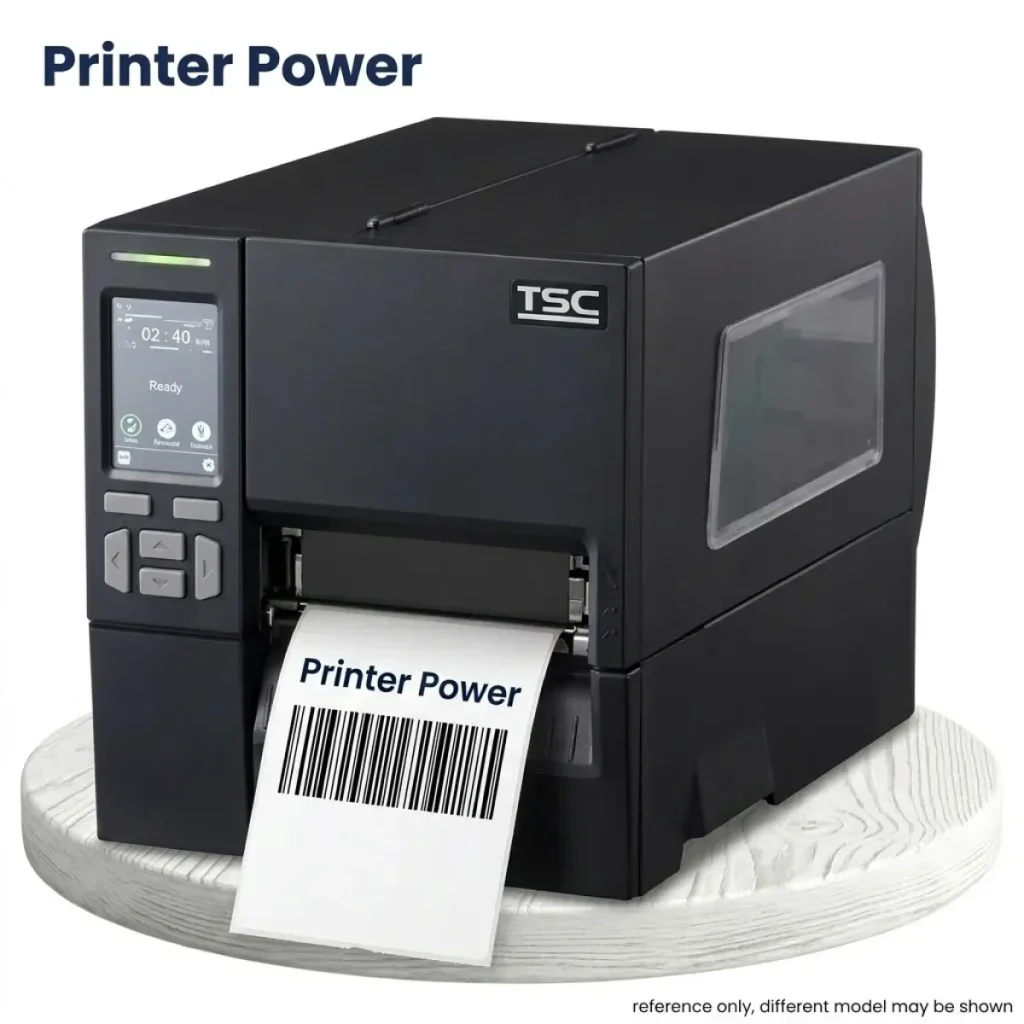
The TSC MB241T 4-Inch Performance Industrial Printer Series is an industrial label-printer family for manufacturing, logistics, retail and healthcare environments. In a poison-label workflow, it can serve as the production device for approved on-demand label formats where the chosen printer configuration, media construction and ribbon are appropriate for the packaging application.
The selected configuration is the TSC MB341T, SKU MB341T-A001-0004. It has 300 dpi resolution, uses thermal-transfer printing, connects through USB and Ethernet, and has no cutter, peel-off or internal-rewinder option in this selected variation. The 300 dpi configuration is suited to labels containing fine text, dense 2D barcodes and detailed compliance graphics where the approved layout calls for high-density imaging.
Official TSC documentation identifies this model family as supporting thermal-transfer and direct-thermal printing. For a workflow focused on durable printed poison information, the selected MB341T thermal-transfer configuration uses a ribbon-based process. The practical outcome still depends on pairing the ribbon with a suitable label material and adhesive for the intended container and conditions.
The MB341T configuration provides USB and Ethernet connectivity, allowing direct host connection or wired network integration. Its 3.5-inch colour touch display, 256 MB Flash memory and 256 MB SDRAM are part of the selected configuration. The broader MB series also uses a bifold media door designed to reduce the operating footprint compared with traditional industrial printers, which can be useful where label production is located at a constrained packing or production station.
Implementation decisions before selecting a printer workflow
Match the label to the container and environment
Start with the actual packaging surface and the conditions the labelled product will encounter. Determine the required permanent-adhesive performance for specified packaging, then evaluate the face stock, adhesive and ribbon combination against handling, moisture, rubbing, heat and storage conditions. The printer is one part of this system; it cannot compensate for an unsuitable label construction.
Choose output handling for the process, not as an afterthought
The selected MB341T-A001-0004 has no factory-configured cutter, peel-off module or internal rewinder. This is suitable where the team’s process does not require automatic separation, peel-and-apply presentation or collection of completed rolls inside the printer. Where a workflow depends on one of those output methods, it should be assessed at the configuration-selection stage rather than assumed to be available on this variation.
Align media format and print design
The MB341T 300 dpi model has a maximum print width of 4.16 inches. The MB series supports continuous, die-cut, black-mark, fan-fold and notch media types. Media format must align with the approved label design and the production method. Gap, notch and black-mark media provide different registration references, while continuous media relies on the defined job length.
Plan for scale and system fit
The selected model is a wired 300 dpi thermal-transfer configuration. It is not the appropriate choice where the operation requires ultra-wide output or a portable mobile-cart workflow without wired infrastructure. Likewise, a business with fully static, very high-volume label designs may compare in-house production with outsourced printed stock as part of its overall cost assessment.
Relevant consumable and workflow options
Resin Thermal Transfer Ribbons Ink Out, SKU DM810110300, is a related catalogue option for organisations assessing ribbon-led label production. Ribbon formulation is a workflow choice: the appropriate formulation depends on the label surface and the resistance required from the printed information. Product-specific suitability and compatibility should be assessed against the selected label construction and printer workflow.
For an Australian poison-labelling operation, the practical objective is a repeatable system: approved label content, a suitable permanent-adhesive label construction where required, a matched ribbon and media combination, and print output that remains legible in the product’s expected conditions. Printer Power can help customers evaluate these choices around the specific labelling workflow.
Find the Right Product
Contact our team to discuss an industrial label-printing workflow for Australian poison-label production, including printer configuration, label media and ribbon selection.