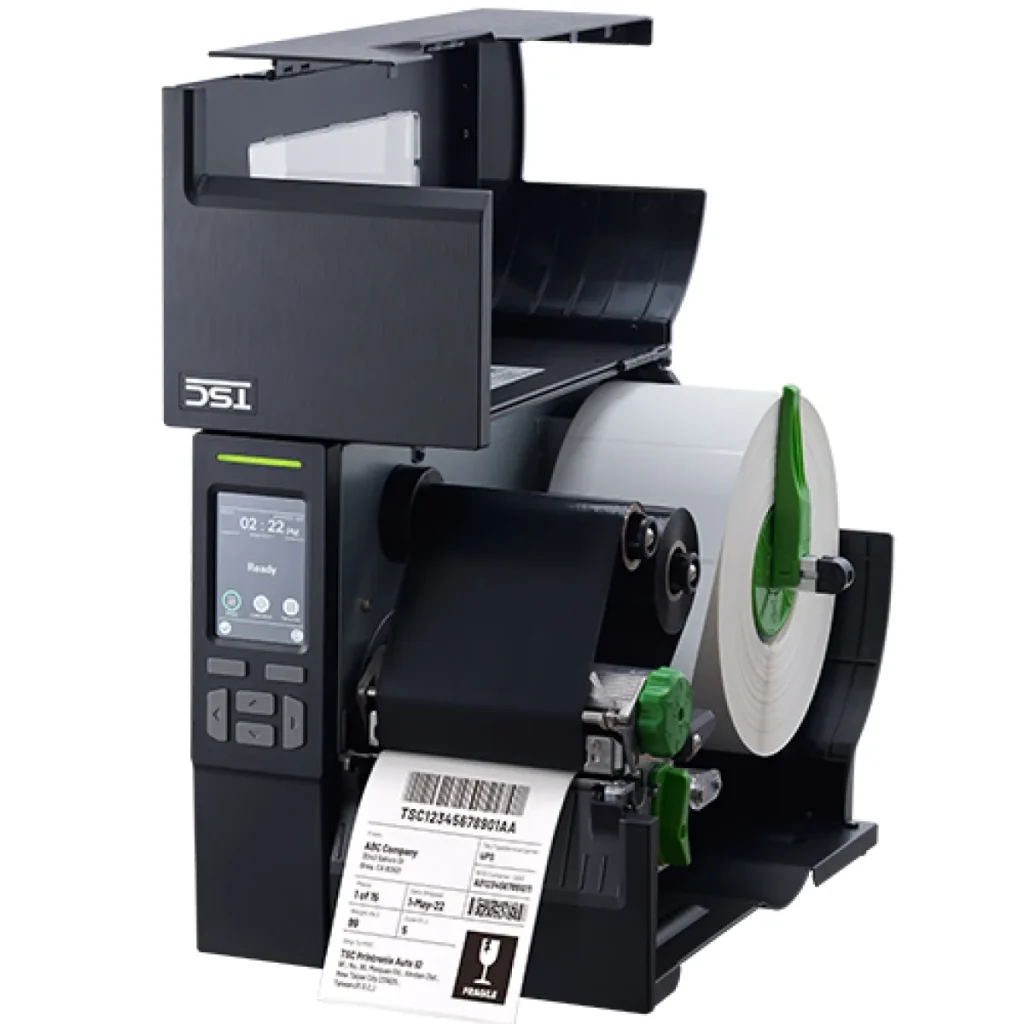
View TSC MB241T 4-Inch Performance Industrial Printer Series
Australian retail is working towards an Ambition 2027 goal for point-of-sale systems to scan approved 2D barcodes. This is an industry readiness objective, rather than an Australian legal deadline or a universal requirement for every organisation. During the transition, a linear barcode remains required on retail trade items alongside the 2D symbol until retail POS capability is widespread.
For Australian brands, manufacturers, food and beverage packers, healthcare suppliers and retail labelling teams, the immediate task is often to move from EAN-13-only packaging artwork to a label that preserves reliable current scanning while accommodating 2D data. EAN-13 remains a current retail barcode on Australian consumer packs. GS1 Australia identifies approved 2D options including GS1 DataMatrix, QR Code with GS1 Digital Link and Data Matrix with GS1 Digital Link.
The dual-marking challenge in Australian product labelling


Dual marking means placing the existing linear barcode and an approved 2D symbol on the same retail label or pack during the transition. The approach allows today’s retail scanning processes to continue while creating a path to encode additional information. GS1 Australia identifies expiry, batch or lot and serial information as examples of data being introduced through 2D symbols.
The workflow affects more than barcode artwork. Product, packaging and traceability teams need to manage the correct GTIN and variable data, produce labels at a consistently readable quality, apply labels in a repeatable position, and test scanning within the relevant retail and trading-partner workflow. A 2D barcode programme is therefore a label-production change as well as a data and packaging change.
Operational requirements for dual-marked labels
A dual-marked label needs sufficient clear space around each barcode and careful placement away from edges, wrapping and likely damage. These considerations matter because handling and packaging can affect scan reliability. Where labels are applied to cartons or palletised goods, the physical application process also needs to preserve barcode visibility when goods are stored, moved and received.
Label material and print method should be considered as a system. Thermal printing forms an image with heat. Direct thermal printing uses heat-sensitive stock without a ribbon, while thermal transfer printing transfers an image from a ribbon onto non-heat-sensitive media. Direct thermal labels can suit shorter-life information such as dispatch or receipt labels. Thermal-transfer workflows are commonly considered where printed identification needs to better tolerate handling, abrasion or more demanding storage conditions, although final performance depends on the complete label, ribbon and operating-environment combination.
Variable-data workflows also need dependable label registration. Gap media identifies the boundary between a label and its liner, while black-mark media uses printed registration marks to locate the next label position. Continuous stock relies on a defined format length. When printed labels skip, drift or show inconsistent registration, the loaded media type, label dimensions and software or driver settings should align with the label format in use.
Where the TSC MB241T 4-Inch Performance Industrial Printer Series fits
The TSC MB241T 4-Inch Performance Industrial Printer Series is an industrial thermal-transfer printer platform for transport and logistics, manufacturing, retail and healthcare labelling workflows. Its full-metal print mechanism, multi-point thermal printhead pressure adjustment and heating-line adjustment are intended to support stable, consistent output across different label materials and printing conditions. This makes the platform relevant to on-demand labels carrying current linear codes alongside 2D symbols, where accurate physical output is part of the wider barcode workflow.
The selected configuration is the TSC MB241T 4-Inch Performance Industrial Printer Series variation SKU MB341T-A001-0404. It has 300 dpi resolution, uses the Thermal Transfer print method, provides USB and Ethernet connection options, and has the supplied option value None. The 300 dpi configuration is a decision point for teams assessing label artwork that includes detailed text or compact barcode content.
For multi-printer environments, the MB Series provides automatic switching between printer-language emulations to assist printer replacement and upgrade projects without requiring existing print commands and label templates to be altered. TSC Console and SOTI Connect support printer-group management, including remote deployment, configuration and updates. Applicable MB241 Series models also provide an embedded web management interface for remote configuration, troubleshooting and monitoring of an individual printer.
Implementation decisions before selecting a printer configuration
Start with the label’s role in the workflow: consumer-pack identification, product information, shipment handling, records, inventory or traceability. Then establish whether the process needs EAN-13 plus a GS1 DataMatrix, QR Code with GS1 Digital Link, or Data Matrix with GS1 Digital Link. The selected symbol and encoded data should align with the intended retail, traceability and trading-partner process rather than an assumption that all EAN-13 barcodes are being replaced.
Next, define the media and output path. The MB Series has options for linerless, peel-off, internal rewinder, cutter and RFID-related capability, but these are configuration and compatibility decisions rather than standard assumptions for every unit. Organisations needing these functions should select the suitable compatible option before purchase. A catch tray is available for compatible MB241T and MB341T printers to help printed material remain flat and protected after printing.
Finally, consider deployment location and administration. On-demand printing near the point of application can reduce trips to a central printer in warehouse and fulfilment processes and can support one-label-per-logistic-unit practices where appropriate. MB241 Series models have a foldable metal side cover designed to reduce required operating space by 24 per cent, supporting media and ribbon changes in constrained work areas. For dual-marking projects across multiple work areas or locations, fleet-management requirements can be as important as the selected print resolution and connection method.
Barcoding Software
BarTender by Seagull Scientific is an industry-standard label design and printing software platform that simplifies automated packaging, RFID tagging, and barcode compliance across global supply chains. To generate GS1-compliant barcodes, BarTender incorporates native GS1 Application Identifiers (AIs) and pre-configured templates for standard linear symbologies like GS1-128, GS1 DataBar, and ITF-14. It provides robust support for 2D barcode formats, including GS1 DataMatrix (widely used in healthcare, pharmaceuticals, and aerospace for encoding detailed trace data in compact spaces), GS1 QR Code, GS1 Digital Link (which encodes web URIs to connect physical items to online product information), as well as standard 2D formats like PDF417, Aztec, DotCode, and MaxiCode. Users can map dynamic operational data—such as Global Trade Item Numbers (GTINs), batch or lot numbers, serial numbers, and expiration dates—directly into the template from business databases or ERP systems. The software automatically formats human-readable text, calculates check digits, and enforces GS1 syntax rules, ensuring generated barcodes scan correctly and comply fully with global supply chain standards.
Making the transition without disrupting current scanning
The practical objective is continuity: retain the linear barcode required for today’s retail trade-item scanning while introducing an approved 2D symbol for the next stage of retail POS readiness. Australian organisations can use the transition to review barcode artwork, variable-data control, label material selection, print consistency, application position and scan-testing processes.
The TSC MB241T 4-Inch Performance Industrial Printer Series, including the 300 dpi thermal-transfer MB341T-A001-0404 configuration, is suited to organisations that need an industrial platform for these transport, logistics, manufacturing, retail and healthcare label workflows. The appropriate final choice depends on the required resolution, media-handling path, connection method and whether printers will be managed individually or as part of a fleet.
Find the Right Product
Contact our team to discuss an industrial label-printing workflow for dual-marked EAN-13 and GS1 2D barcode labels.