View TSC MB241T 4-Inch Performance Industrial Printer Series
Australian food labelling has attracted renewed public and regulatory attention following an ABC report on 7 August 2026 that the Australian Competition and Consumer Commission had opened an inquiry into allegations of misleading food labelling and packaging. For food brands, importers, packers and processors, this focus makes label control an operational priority: origin statements, supplier information, approved packaging artwork and variable production data need to align before labels are printed and applied.
Lot, batch and date information also has a practical traceability role in packaged-food workflows. When a business can identify the production run associated with a product, it is better placed to isolate relevant stock during a recall process. Printer Power can help businesses assess a label-printing workflow that reflects the data, media and output-handling needs of their operation.
Food labelling workflow: control the data before printing
A food traceability label is most useful when it is the visible result of controlled source information. A practical workflow begins with approved label content, including the relevant product identity, origin claim and variable lot or batch data. The production team then needs a reliable way to select the correct template and populate it with the correct run-specific information.
This approach reduces the risk of treating the printer as the only control point. Label templates, artwork approval and production records each influence what appears on pack. Where barcodes are used for inventory, carton or pallet movements, the encoded data and printed symbol both matter. A barcode can appear complete yet scan poorly if contrast is weak, bars or modules are damaged, symbol sizing is unsuitable, quiet zones are obstructed, or surrounding gloss, folds and graphics interfere with scanning.
For warehouse and distribution activity, scannable labels can support receiving, inventory identification, carton tracking and pallet movements. Applying equivalent pallet information on two sides may also reduce rescanning where stored pallets can face in different directions.
Operational requirements for origin, lot and recall-ready labels
Variable data must be tied to the correct production context
Origin claims and supplier-related statements should be managed alongside the records and approved artwork that support them. Lot and batch identifiers should be generated or selected in a manner that clearly relates labels to the relevant production run. This is particularly important where the same packaging format is used across multiple suppliers, origins or batches.
Label material must suit the handling environment
Thermal-transfer printing uses heat to move a wax- or resin-based ribbon coating onto a label. Unlike direct thermal printing, which relies on heat-sensitive media, thermal transfer requires a suitable ribbon-and-label combination. The appropriate choice depends on the required label life and the conditions experienced in storage, transport and handling.
Ribbon chemistry and label face stock influence adhesion, definition and resistance to abrasion, heat or chemicals. Representative labels should therefore be assessed in the actual handling environment before a broader rollout. Printer Power lists Wax/Resin Thermal Transfer Ribbons Ink Out, SKU B110A, and Resin Thermal Transfer Ribbons Ink Out, SKU B110C, as related thermal-transfer consumable categories for workflows where ribbon selection is part of the label-system decision.
Print registration and scan quality need routine attention
Label formats may use gaps, continuous media or black marks to establish where printing begins. Gaps are detected between labels and liners, black-mark media uses a printed mark, and continuous media relies on the defined length in the print format or software. A mismatch between configured media and loaded stock can contribute to inconsistent feeding or vertical drift.
Print quality is an operational control when labels are scanned by warehouses, carriers or customers. Reviewing representative labels helps identify fading, contamination, poor contrast, unsuitable materials and layout issues before they create widespread scan failures.
How the TSC MB241T series can support controlled label production
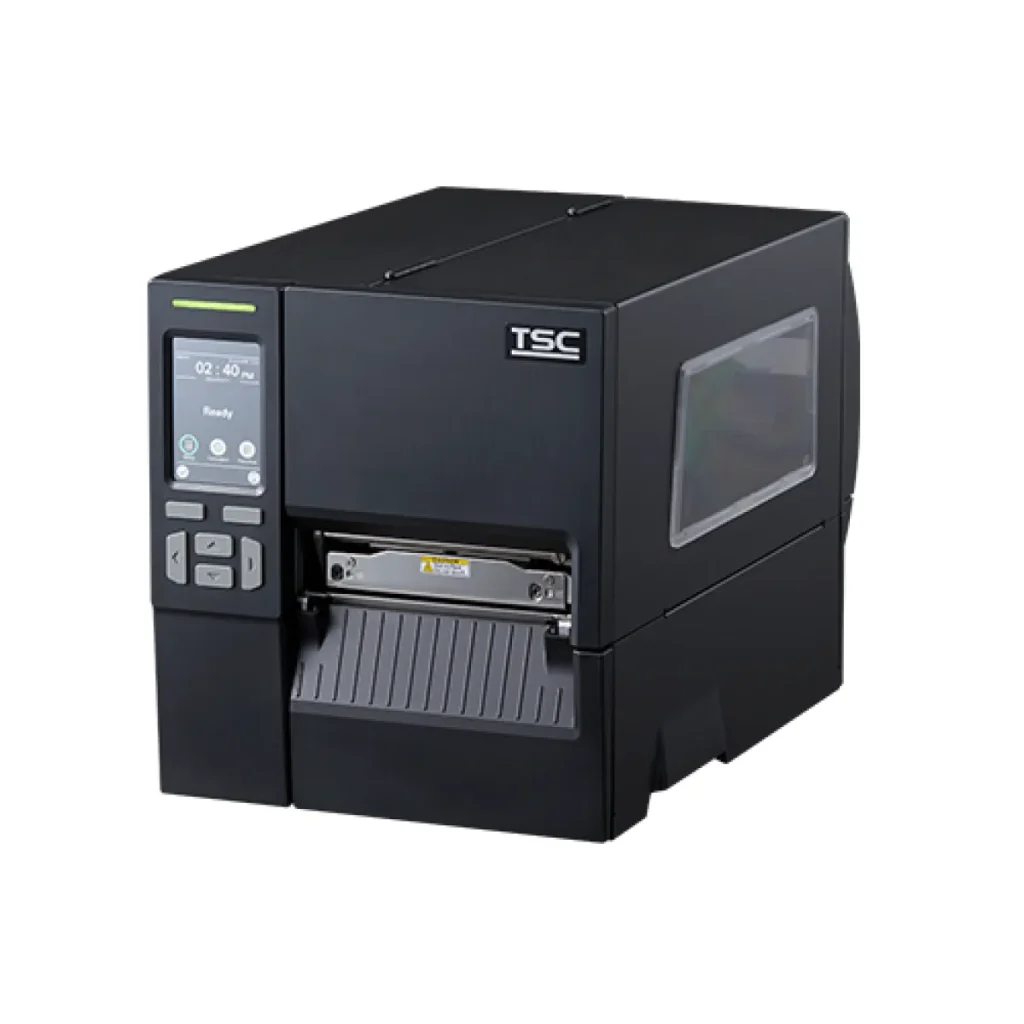
The TSC MB241T 4-Inch Performance Industrial Printer Series is an industrial thermal-transfer printer range suited to transport and logistics, manufacturing, retail and healthcare labelling workflows. Its full-metal print mechanism, configurable media-handling options and fleet-management tools make the platform relevant where labels are produced consistently within day-to-day operations.
For a food-related traceability workflow, the TSC MB241T series can be considered where a business needs thermal-transfer label output alongside configurable handling and administration options. The range includes multi-point thermal printhead pressure adjustment and heating-line adjustment to support consistent output across different label materials and print conditions. It is also designed to handle specialised media, including firmer or thicker hangtags.
The selected configuration is the TSC MB241T, SKU MB241T-A001-0404. This variation has 203dpi resolution, Thermal Transfer print method, USB and Ethernet MFi BT connection, and Option: None. It is identified with a 3.5-inch touch LCD and includes USB, RS-232, Ethernet, USB host and RTC in its stated configuration.
For operations with limited working room, MB241 Series models have a foldable metal side cover that reduces required operating space by 24 per cent while supporting access for media and ribbon changes and routine cleaning. The broader MB Series platform also has optional linerless, peel-off, internal rewinder, cutter and RFID-related solutions, but these capabilities are configuration and compatibility decisions rather than standard functions of the selected MB241T-A001-0404 variation.
Implementation decisions before selecting a printer configuration
Printer selection should follow the workflow, rather than lead it. First define the approved label templates, the variable data fields, the expected label material and the required output path. Then consider whether labels are dispensed individually, cut, rewound or collected after printing, and whether the printer will be operated as a standalone device or administered with other units.
The MB Series includes automatic printer-language emulation switching, which can assist replacement or upgrade projects by reducing the need to alter existing print commands and label templates. TSC Standalone Creator can create printer LCD menu interfaces for template access, while TSCPRTGo can extend the printer interface to a mobile device. SOTI Connect and TSC Console support printer-group management, including remote deployment, configuration and updates. Applicable MB241 Series models also provide an embedded web management interface for remote configuration, monitoring and troubleshooting of an individual printer.
These management capabilities may be valuable for a business using controlled templates across several work areas or locations. They do not replace the underlying governance needed for approved origin claims, supplier records, batch data and artwork changes.
Fit limitations and decision points
The TSC MB241T 4-Inch Performance Industrial Printer Series is not a one-configuration answer to every traceability application. Resolution, display format, connectivity and output handling differ across the MB241T and MB341T range. MB241T configurations use 203 dpi printing, while MB341T configurations use 300 dpi printing.
The selected MB241T-A001-0404 configuration is a 203dpi thermal-transfer model with USB and Ethernet MFi BT connectivity and no listed output-handling option. Businesses requiring cutting, peel-off dispensing, 5-inch internal rewinding, linerless printing or RFID-related capability should choose a suitable compatible option as part of their workflow design. A catch tray is available for supported use cases to help keep printed material flat and protected after printing.
Packaging and casing for the MB241 Series are recyclable, and more than 90 per cent of printer components are described as recyclable. This may be a relevant consideration for organisations incorporating equipment lifecycle considerations into their label-workflow planning.
Find the Right Product
Contact us to discuss a food traceability label workflow, including the TSC MB241T 4-Inch Performance Industrial Printer Series and appropriate label and ribbon considerations.