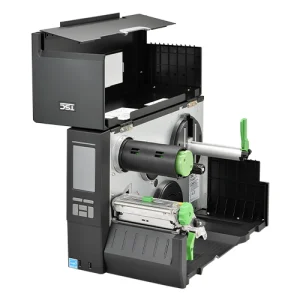
The TSC MH241T Series is an industrial-grade thermal transfer label printer intended for high-volume work such as shipping, inventory management and product labelling. The selected configuration is the base model of SKU MH241T-A001-0004, with 203dpi resolution, Thermal Transfer print method, USB and Ethernet connection. For ownership planning, the purchase decision should account for recurring consumables, expected print volume, productivity requirements, energy use and the operational effect of printer downtime.
Initial equipment scope and workflow fit
Initial cost is only one component of ownership. The selected TSC MH241T Series configuration combines 203dpi printing with USB and Ethernet connectivity, supporting use within local workstation and networked workflows. Its 4.3-inch touch LCD, 256MB DRAM and 512MB Flash are part of the supplied configuration, while the industrial construction is intended for demanding environments.
When comparing initial equipment outlay, assess the capabilities that directly match the application: the required print resolution, expected label workload, connection method and whether the selected configuration’s no-option specification suits the operation. This approach avoids paying for configurations outside the needs of the labelling process while ensuring the printer is appropriate for the work being assigned to it.
Consumables: labels, ribbon and media workload
Thermal transfer printing makes label media and ribbon ongoing ownership inputs. Their consumption will be driven by the number of labels printed, label dimensions, print coverage and the production schedule. A higher-volume shipping, fulfilment or manufacturing workflow will generally require more frequent replenishment than occasional product labelling.
The MH241T is designed to handle rolls, fanfold media and external media supplies. It also includes media-near-end detection with a movable sensor, providing a prompt when the media supply is approaching its end. In cost planning, this function should be considered alongside the operational cost of media changes: frequent changeovers can affect labour time and interrupt label production, particularly where output is continuous.
The printer’s ribbon-tension and mechanism-adjustment provisions are intended to support consistent thermal transfer output and help address ribbon wrinkles. For a total-cost comparison, record expected media and ribbon consumption for a representative print run, then apply that consumption rate to the organisation’s forecast annual label volume.
Productivity and downtime exposure
For industrial label printing, the cost of interruption can be as important as the cost of consumables. The MH Series is specified with 203dpi models capable of print speeds up to 14 ips, and the MH241T is positioned for high-volume label production. Output capacity should be compared with peak demand, not only average daily volume, because delayed labels can affect dispatch, inventory processing and production identification workflows.
The TSC MH241T Series includes printhead health monitoring through TSC Sense Care technology. This real-time monitoring is intended to identify printhead health conditions and help prevent downtime. Crisp, scannable barcodes and clear text also matter to operating cost because print-quality problems can create reprint work and disrupt barcode-based processes.
The colour touch interface can also influence labour efficiency by presenting operating information and adjustment controls on the printer. In a cost-of-ownership assessment, consider the time required for routine operator interaction, media-change events and response to print-quality or status alerts.
Energy and connected fleet management
The TSC MH241T Series has Energy Star certification, which is relevant when evaluating electricity as part of ongoing operating cost. Energy consumption should be assessed across the actual duty cycle, including the number of printers operating, expected active printing hours and idle periods.
Ethernet connectivity can also affect the administrative component of ownership where printers are deployed across a workplace network. TSC Console Web provides centralised status monitoring, usage information, error-log reporting and remote configuration functions for supported printer environments. For multi-printer operations, compare the time spent monitoring individual devices against the value of central visibility into printer status and job progress.
A practical total-cost comparison framework
Use the same evaluation period and expected workload for every printer under consideration. Rather than relying on purchase price alone, build a comparison around the following cost drivers:
- Initial equipment: the configured printer and the connection requirements for the intended workflow.
- Consumables: projected label media and thermal transfer ribbon use for the planned print volume. Also include consumables such as Thermal Printheads.
- Labour: time associated with loading media, changing ribbon, monitoring supplies and managing printer status.
- Productivity capacity: whether print speed and output quality meet normal and peak label demand.
- Downtime exposure: the operational effect of unavailable label production, reprints and delayed barcode scanning.
- Energy: electricity use over the printer fleet’s expected duty cycle.
- Management overhead: the effort required to monitor, configure and review networked printers.
The TSC MH241T Series is best assessed as a high-volume industrial labelling asset: the relevant ownership question is how its thermal transfer consumables, 203dpi output, USB and Ethernet connectivity, printhead monitoring and Energy Star certification align with the organisation’s ongoing label-production workload.
Find the Right Product
Contact our team to discuss the TSC MH241T Series in relation to your expected label volume, media use and networked printing workflow.